The Carignan-Salières regiment and the companies of Tracy
In 1665, 1300 soldiers landed in New France. Among them were the ancestors of François Baby, who would have the manoir les Becquets built, and the future seigneur of Deschaillons; some 285 stayed on after the peace of 1667.
Written in French by Gilles Marchand, September 22, 2026. Quotations from period documents are left in the original. Lire l’original en français.
The first French troops in New France
Today we offer you a piece of history reaching back to 1665: an overview of some of the events surrounding the dispatch to New France, by King Louis XIV, of 1300 soldiers. Part of that force — the Carignan-Salières regiment, made up of 20 companies — sailed from France. The rest, the 4 companies of Tracy, sailed from the Antilles. Each of the 24 companies had three officers: a captain, a sergeant and a standard-bearer, also called an ensign, together with about 50 soldiers. An ensign was a non-commissioned officer whose role was to serve as a visual marker for the troops, by means of a flag, to hold the unit together and to show the honour and the courage of his company.
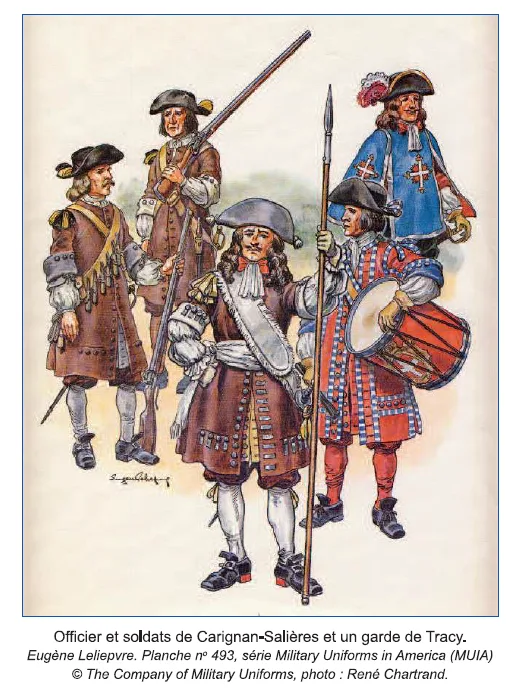
For the Atlantic crossing, King Louis XIV had chartered 5 ships, each able to carry about 230 passengers. The fastest crossing between the town of La Rochelle and Québec was made in 61 days by the Saint-Siméon, while that of the Justice took 113 days, very nearly twice as long. The length of a voyage in those days depended on the route taken, on favourable winds or the lack of them, on the skill of the captain and his crew, and on how the ship performed. When the Justice reached Québec, close to half the soldiers aboard — about a hundred — had to be rushed to the Hôpital Général in Québec, gravely ill and very weak. A few days later, 35 of those men were dead. Conditions aboard that ship must have been appalling, given the extreme length of the voyage and the shortage of food that followed from it.
It is worth noting here that the St-Ours company made the crossing aboard the Justice, and that its sergeant was named Jacques Baby, its ensign Thomas de Lanouguère (whose descendants took the surname Tarieu de Lanaudière) and its captain Pierre de Saint-Ours de l'Échaillon. The first two are the direct ancestors of one François Baby. Yes — the man who, some 150 years later, had the manoir les Becquets built at Saint-Pierre-les-Becquets, in 1817. As for the third, Pierre Saint-Ours de l'Échaillon, he was the one who inherited the seigneury that was named Deschaillons.
The regiment's task was to counter the relentless attacks of the Iroquois peoples, who were a standing threat both to the young colony of a little under 4000 souls and to the allied Indigenous peoples. The Iroquois territories lay south of Lake Huron, near the English and Dutch colonies, which were in direct competition with the French colony for control of the fur trade in America. To encourage the Iroquois to attack the French settlers living near Montréal, near Trois-Rivières and in the hamlets strung along the St Lawrence, the English are said to have supplied some weapons and to have paid the Iroquois when they brought in French scalps. An end had to be put to these constant threats to the safety of the inhabitants of New France and of their allies.
The regiment's first task was to build 4 forts along or near the mouth of the Richelieu, which was done in the autumn of 1665 and the spring of 1666. The soldiers also carried out two punitive expeditions into Iroquois territory. The first was a disaster, because the senior officers launched it in December 1665 without waiting for the Algonquin guides who were to lead and advise them. The soldiers were not dressed warmly enough and were caught out by high winds, cold and heavy snow. By the end of that expedition, close to 60 of the 500 soldiers who took part are believed to have died of cold or in Iroquois ambushes. That year the enemy proved to be the winter conditions as much as the Indigenous peoples!
The second expedition was carried out in the autumn of 1666 and, though it is not counted a military success, it did burn several Iroquois villages whose inhabitants had chosen to flee. That persuaded the Indigenous leaders to sign peace treaties with the French authorities, establishing « La Grande Paix de 1667 » (the Great Peace of 1667).
A few months after the treaties were signed, the soldiers were demobilised and the colonial authorities offered them land to persuade them to settle in New France. Some 285 of the former soldiers accepted; the rest went back to France. Jacques Baby, Thomas de Lanouguère and Pierre Saint-Ours de l'Échaillon were among these courageous new settlers. There is no doubt that what they had come through on their first Atlantic crossing aboard the Justice weighed heavily in their decision to stay and settle in Canada, in 1668.
The first two married young women born in the colony, while Pierre de Saint-Ours de l'Échaillon married one of the King's Daughters. Their respective lines today count many descendants in Québec and across North America. The overall demographic effect of the new settlers from the Carignan-Salières regiment and of the King's Daughters was dramatic. The colony's population is thought to have tripled in 20 years, from fewer than 4,000 inhabitants in 1665 to 12,000 in 1685! The total descent of the soldiers who settled in Canada is reckoned today at more than 500,000 people, according to Fournier and Langlois.
As we can see, the Carignan-Salières regiment and the companies of Tracy had a considerable effect on Québec and on our own region:
- They made possible a peace without which the colony could not have survived;
- They helped our French-speaking community in America to grow;
- They made possible the immigration of the ancestors of the first seigneurs of the Lévrard-Becquet seigneury which, as we all know, itself led to the founding of our three villages of Saint-Pierre-les-Becquets, Sainte-Cécile-de-Lévrard and Sainte-Sophie-de-Lévrard;
- They also brought to Québec the first seigneur of the seigneury of Deschaillons, which led to the founding of the village of the same name!
Other descendants of the soldiers of Carignan-Salières may well live in our municipalities. If you have information on the subject, do not hesitate to get in touch and let us know!
Gilles Marchand
Where this article sits
Read next
About the Society
A group of volunteers researching, preserving and publishing the history and genealogy of the Lévrard-Becquet seigneury since 2002.
shglb.com/en/le-regiment-carignan-salieres/