The Mills
With Jocelyne Lafond

Mills were vitally important elements in the rooting of rural populations in New France. Without a mill, there was no way to grind grain into flour; some mills could saw tree trunks into beams, joists, boards and shingles; and carding the wool of sheep went far more quickly with the help of a mill than by hand.
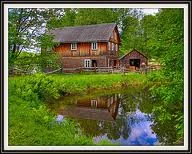
To date we have identified at least twenty mills on the territory of the seigneury (seigneurie, the landholding unit of New France), most often along the banks of the rivière aux Orignaux and its tributaries, but also on the rivière du Chêne and on certain streams; all of them depended on water power to operate, and we know of no windmill here.
Going up the rivière aux Orignaux from its mouth on the St. Lawrence River, we come first upon a mill on lot 178, at the intersection of the river and the road of the second rang (rang: concession road, a row of farm lots), today the rang St-Charles; a little farther upstream, landlocked among the farms, a second mill occupies lot 190; at the level of the third rang, on lot 343, one finds the ruins of a third mill and of the farmhouse attached to it. Note that these mills are not described in chronological order, but in the order in which they came to light.
We are currently preparing a file on the very first mill (the banal mill, the seigneurial mill tenants were required to use), built close to Deschaillons on lot 1.
In this topic
- The Mill on Lot 178The chain of owners of the flour mill on the Rivière-aux-Orignaux, from Landry Lafond’s sale in 1866 to the fire of 1957-58; the municipality bought the land back in 1970.
- The Mill on Lot 190Lot 190, landlocked among the farms, carried a sawmill by 1871 and later a shingle mill; the Society follows its owners, from the Barabé brothers to Jacques Delisle.
- The mill on lot 343The flour mill on lot 343, on the Rivière-aux-Orignaux, traced through notarial acts from Télesphore Jacques before 1871 to its closing in 1948 and the tax sale of 1970.
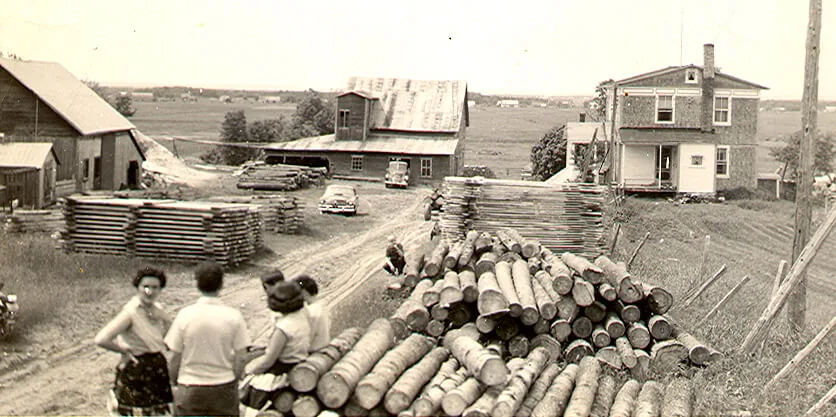 The Mill That Became a WaterworksFrom lot 419 in the fifth rang, the Moulin des Sources passed from Frédéric Boulanger to the Barabés, who built a waterworks in 1903; the sawmill ran until 1961 and the spring still supplies users.