The militiamen of 1812 at St-Pierre-les-Becquets
The seigneurie Lévrard supplied at least five militiamen to the War of 1812: pay of $20.00, the free land Hyacinthe Cossette took up in 1839 and resold, and a claim rejected in 1874.
Written in French by Alain Manset, December 21, 2015. Quotations from period documents are left in the original. Lire l’original en français.
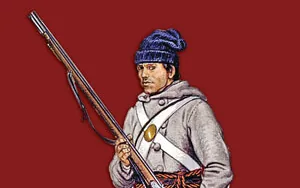
In 1812, war broke out between the United States of America and the British Empire. To defend its frontiers in America, the United Kingdom raised a rather mixed body of troops made up of English-speaking Canadians, American Loyalists, Native peoples, Swiss and German mercenaries, and French-speaking Canadians. Among the latter there were few volunteers, many conscripts, and many men called to the colours who vanished into the countryside before ever reaching their barracks. History would repeat itself 100 years later.
Unlike professional soldiers, militiamen were civilians enrolled either willingly or otherwise.
Extracts from the list of militiamen of the War of 1812




In our region, the seigneurie Lévrard (seigneury, a landholding of the seigneurial regime) supplied at least five militiamen:
Alexis Houle and Martin Brousseau served in the first battalion of the Militia; Isidore Brousseau, brother of the preceding, Olivier Pépin and Hyacinthe Cossette were attached to the 5th Battalion. Each received his pay of $20.00 for the length of his service, more than two years. The federal government had also promised them additional compensation.
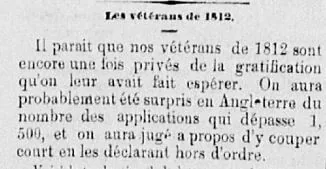
On 24 September 1874 the Journal de Trois-Rivières reported that three of them had applied for their “promised wages” — 60 years after the end of the war!
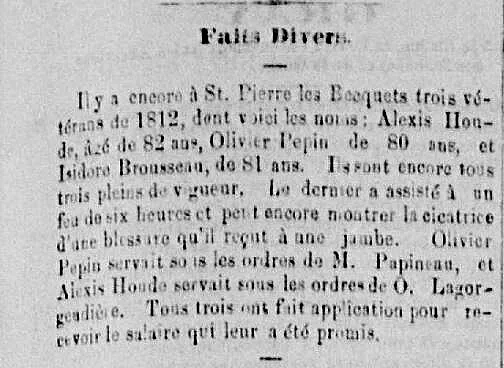
The same newspaper noted on 28 September that the application had been rejected.
Hyacinthe Cossette made good use of the government’s offer, under which he was entitled to a free parcel of land taken from the crown lands. He took possession of it in 1839 and resold it to Alexandre Miller, a merchant of Saint-Pierre.
The practice had the advantage, for the federal government, of displaying a generosity that cost it nothing while stimulating the development of a region by attracting settlers. The militiaman came into possession of land he might never have been able to afford, and which he was free to resell to the highest bidder.
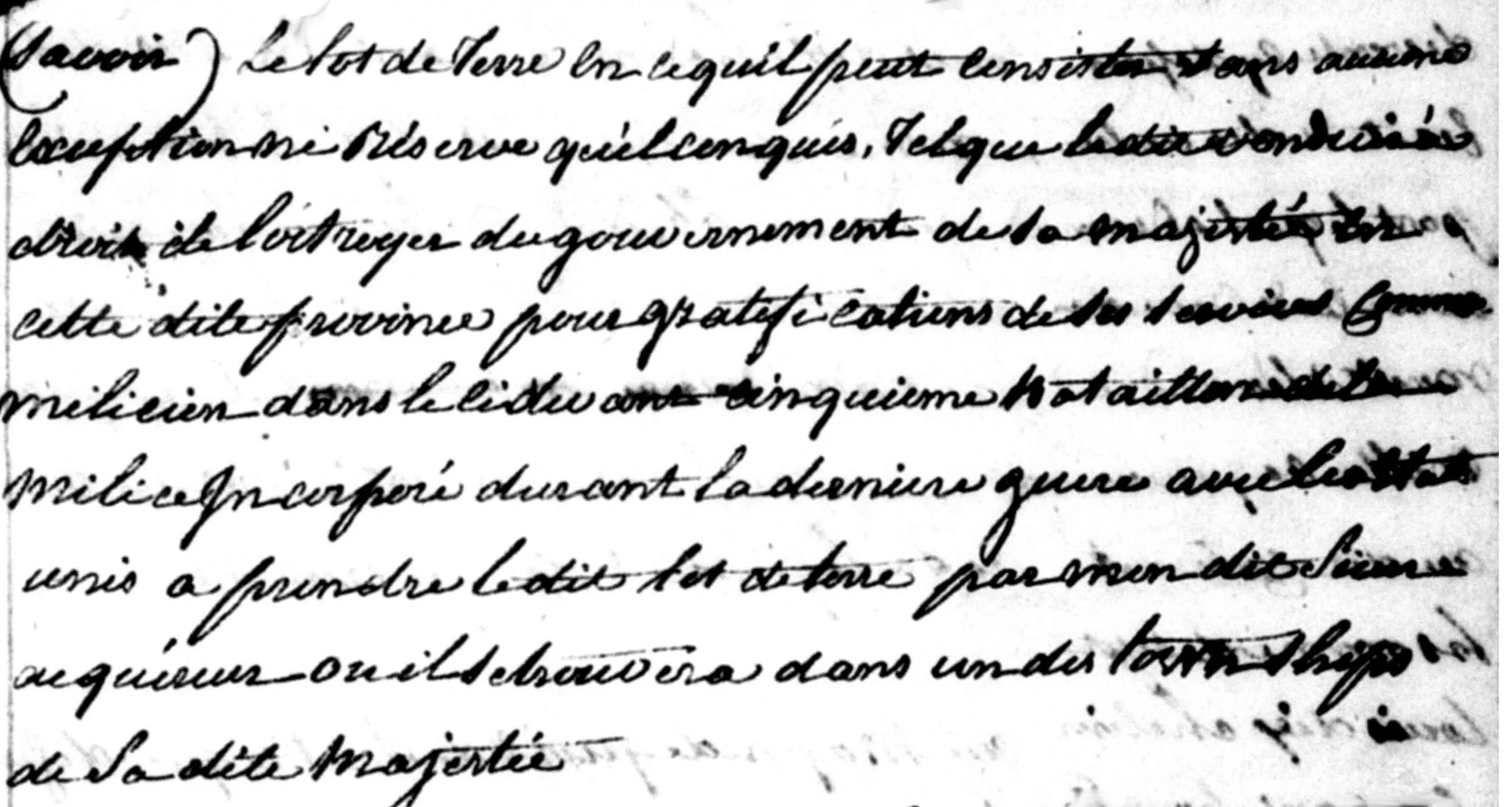
…Le lot de terre en ce qu’il peut consister sans aucune exception ni réserve quelconques, tel que le vendeur a droit de l’octroyer du gouvernement de sa majesté en cette dite province pour gratifications de ses services comme milicien dans celui du cinquième bataillon de la milice incorporé durant la dernière guerre avec les états-unis, à prendre le dit lot terre par l’acquéreur ou il se trouvera dans un des township de sa dite Majestée. N.B.: the spelling mistakes have been preserved in this transcription.
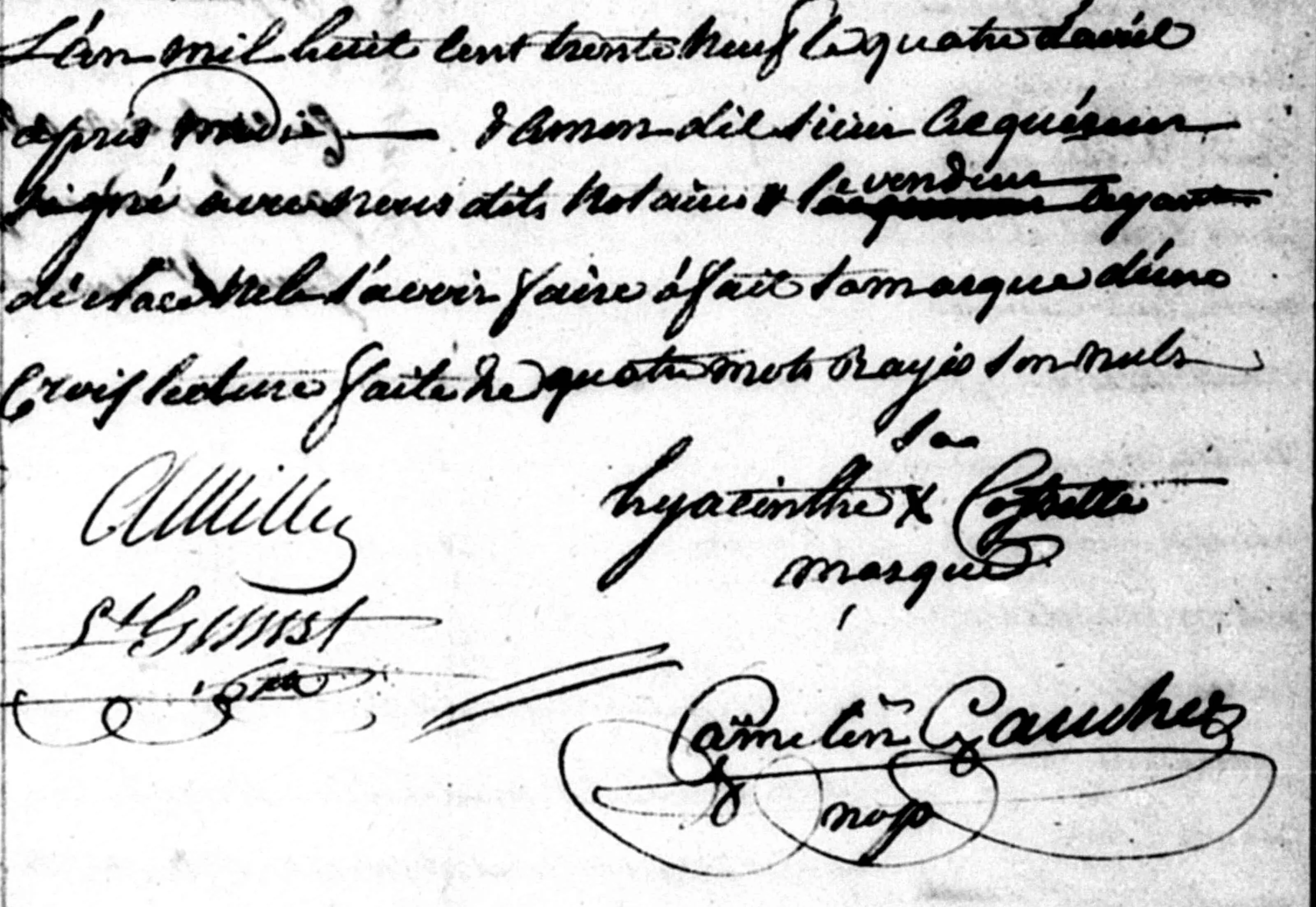
Here we see the signatures of the two notaries, Gamelin Gaucher and Guillet, along with that of the purchaser, Miller. As Hyacinthe Cossette could not sign his name, his « marque » [mark], a simple cross, was authenticated by the notaries.
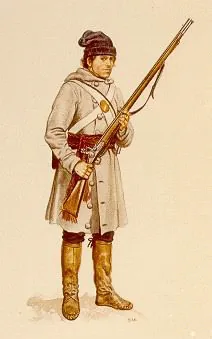
Here we see a militiaman in full winter uniform: a long grey greatcoat (capote), leather boots, a brightly coloured sash (ceinture fléchée, the arrow sash) and a woollen cap whose colour varied by district. For the “government” of Trois-Rivières, the cap was white.
Jocelyne Lafond, Alain Manset, SHGLB
Sources: https://archive.org/details/cihm_93576 pp. 14, 43, 70
Journal de Trois-Rivières, September 1874, BAnQ
Where this article sits
Read next
About the Society
A group of volunteers researching, preserving and publishing the history and genealogy of the Lévrard-Becquet seigneury since 2002.
shglb.com/en/les-miliciens-de-1812-a-st-pierre-les-becquets/