The municipal water system, from then to now
From the wooden pipe of 1850 to today’s plastic: the municipality buying the system back in 1965, the spring in the 5th rang, the filtration of the 2000s and the works of 2021 to 2024.
Written in French by Rénald Paquin and Gilles Marchand, September 22, 2026. Quotations from period documents are left in the original. Lire l’original en français.
Around 1850 a number of small, rudimentary water systems served the people living in the settlements of the Lévrard-Becquet seigneury that later became the villages of Saint-Pierre-les-Becquets, Sainte-Cécile-de-Lévrard and Sainte-Sophie-de-Lévrard. Those systems did not reach the houses out along the rangs (the concession roads), which had to wait until about 1930 for municipal water to arrive.
The small wooden systems of 1850 drew their water from the surrounding watercourses and distributed it, with no prior chlorination, through hollowed-out wooden pipes about four feet long, fitted one into the next (see photograph). Sometimes a lift wheel or a steam pump was added to build the pressure needed to serve every user — on the ground floor of the houses, at least!
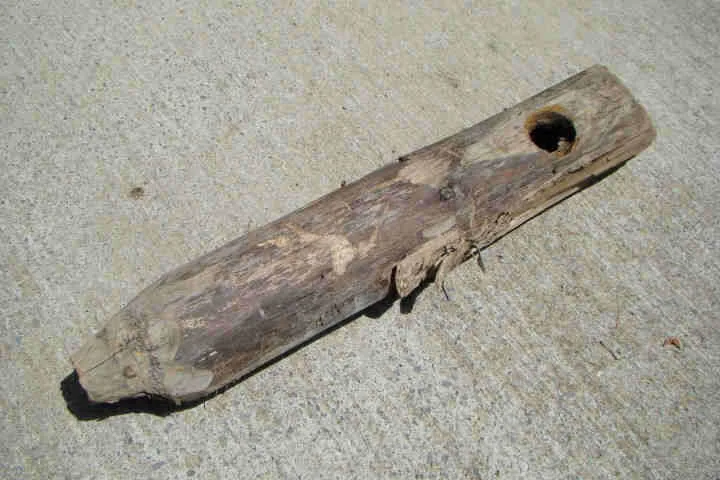
It is hard to trace the history of every water system serving the people of our territory, but here is what has been found for the supply of Saint-Pierre, Sainte-Cécile and part of Sainte-Sophie:
In 1894 we find Ernest Dion acquiring a wooden system serving the village of Saint-Pierre-les-Becquets (1st rang);
In 1898 the municipal council granted Mr Dion the right to operate his system for twenty-five years. Water cost $6 a year at the time, for water said to be of good quality — although the surface water used came from the surrounding watercourses, themselves fed by run-off from working farmland and often used for raising livestock;
In 1919 the system was bought by Ludger Sauvageau, a « fabriquant de beurre » (butter maker), and the council granted him the right to operate and manage a water system in the 1st rang for twenty-five years. The municipality required, however, that every house in the 1st rang between the boundary of the village of Saint-Jean-Deschaillons and the iron bridge by the church be served.
Meanwhile, in 1903, Lubin and Thomas Barabé, owners of the spring mill on lot 419 of the 5th rang, found that their spring produced far more water than they needed to run the mill. They therefore set about supplying drinking water to houses in Ste-Cécile and Sainte-Sophie through a new wooden system;
None of the rudimentary wooden systems was watertight, and they sometimes carried contaminated water, particularly where it came from brooks crossing farmland, as in the 1st rang of Saint-Pierre: « la qualité de l’eau est souvent sujette de plaintes, les fuites régulières exaspèrent, le risque de maladies contractées par l’eau insalubre augmente, le peu de performance lors d’incendies inquiètent les citoyens et les élus, de plus, les compagnies d’assurance et le service provincial d’hygiène publique font de plus en plus pression sur les municipalités »;
From 1925 to 1930, difficult exchanges between Mr Sauvageau and the municipality over the quality of the water and of the service in the 1st rang led at last to the founding of a cooperative society to improve and operate the water system. Around 1930 much of the system was rebuilt at a cost of $10,000 using metal pipe, then extended, notably to serve the 2nd rang;
In 1965 the municipality bought this water system back in order to begin a major improvement project. First, the spring in the 5th rang, at Sainte-Sophie-de-Lévrard, was bought from Mr Gérard Demers for the sum of $8,000. In doing so the municipality secured a supply of high quality, since the water of that spring comes up filtered from underground rather than from brooks or rivers often contaminated by farming or sewage. That good spring water, carried to a reservoir by a supply main along Route 218 and given basic chlorination as well, made it possible to improve the supply to the people of Saint-Pierre, Sainte-Cécile and part of Sainte-Sophie a great deal. It is the water we drink today. The improvement project, carried out in 1966 at a total cost of $525,000, also included replacing the water mains of the built-up part of Saint-Pierre with steel or cast-iron pipe;
Over the years 1990 to 1992, the metal pipes in the 2nd rang, and those of the 1st rang of Saint-Pierre outside the built-up area, were replaced because they broke too often, owing to rust;
In the early 2000s the municipality of Saint-Pierre added a sand filtration system to improve the quality of the water from its spring, together with ultraviolet disinfection and an injection of residual chlorine, in order to comply with Québec's drinking-water regulations;
More recently, from 2021 to 2024, the municipality of Saint-Pierre carried out its wastewater treatment project and took the opportunity to replace the water mains of the village sector, some of them nearly sixty years old and subject to many leaks and very frequent breaks. The municipalities of Sainte-Cécile and Sainte-Sophie are also replacing their pipes, a stretch at a time. The new pipe being laid is plastic, and it should last a very long time, since it does not rust!
So that is the story of our regional water system, which has gone from wooden pipe to steel, to cast iron and now to plastic; which at the outset distributed untreated surface water, then water with basic chlorination, and at last through an elaborate and more robust system that guarantees excellent quality in the water it delivers;
Since foresight is nonetheless in order, the municipality of Saint-Pierre has recently carried out an analysis of the vulnerability of the catchment feeding its supply (the infiltration of rain and snowmelt through the soil). Over the coming years that study could lead to further measures — to reduce, for instance, the risks from an accidental spill of chemicals in a road accident, or from incompatible farming practices. Belt and braces, you will say; but where drinking water is concerned, one is never too careful!
We can learn more about the development of water systems by going to the site of the Société d'histoire et de généalogie Lévrard-Becquet at www.shglb.com. An article entitled Les aqueducs, by Claudette Fournier, recounts the history of the water systems of our territory from 1894 to 1966. And in a document written by Jocelyne Lafond, entitled Le moulin qui devint aqueduc, a great deal of further information can be found, particularly in the chapter entitled Fin du moulin et début d'une nouvelle carrière.
Rénald Paquin and Gilles Marchand, for the SHGLB
Where this article sits
Read next
About the Society
A group of volunteers researching, preserving and publishing the history and genealogy of the Lévrard-Becquet seigneury since 2002.
shglb.com/en/laqueduc-municipal-dautrefois-a-aujourdhui/