The physicians
Henry Arnaud, who died at Saint-Pierre-les-Becquets in 1743 leaving no trace of a medical practice, and Pierre de Sales Laterrière, travelling physician-apothecary from 1783 to 1788, at odds with Father Demers.
Written in French by Alain Manset, May 25, 2015. Quotations from period documents are left in the original. Lire l’original en français.
Physicians at St-Pierre-les-Becquets
Henry Arnaud
Born at Marseille in 1693, he first married Catherine L’Archevêque in 1722; he is then known as a surgeon at Québec until 1738; afterwards he settled at Sainte-Anne-de-la-Pérade as a merchant. In 1739 he married Marie-Marguerite de Chavigny; on 10 September 1740, Henry Arnaud and his wife borrowed 1,500 livres from sieur Nicolas-Gaspard-Boucoult, « Conseiller du Roy et lieutenant particulier de la Prévôté de Québec et Lieutenant-général de l’Amirauté de Québec » [King’s Councillor and special lieutenant of the Provostship of Québec, and Lieutenant-General of the Admiralty of Québec], in order to support his trade, as that old contract puts it.
But a year later, in 1741, he is at Saint-Pierre-les-Becquets; we have found no trace of any medical practice in our village, where he died on 2 September 1743, in his mid-fifties. He is buried in the parish cemetery.
The inventory of the goods of Henry Arnaud, described as « vivant marchand demeurant en la seigneurie de Saint-Pierre-les-Becquets » [in his lifetime a merchant residing in the seigneurie (seigneury) of Saint-Pierre-les-Becquets], lists no surgical instrument and no remedy. In that period physicians could not live on their patients, who were far too poor, and most often had to draw their income from commercial ventures. A fleeting stay, which left so few traces!
Pierre de Sales Laterrière
This man led a rather unconventional life. Born at Albi, in the south of France, in 1743, he emigrated to Canada in 1766, a few years after the « conquête anglaise » [the English conquest]. He had some notions of medicine, which he broadened with Doctor Duberger at St-Thomas-de-Montmagny. His own accounts are to be treated with caution, for he cultivated the art of embellishing the truth.
He became inspector of the Forges du St-Maurice, then, a little later, suspected of sedition, spent four years in prison at Québec.
He then went into exile in Newfoundland, only to return to the region of Bécancour, Gentilly and St-Pierre-les-Becquets between 1783 and 1788. He was known there as a travelling physician-apothecary, covering the territory as far as St-Hyacinthe in a carriole drawn by two horses, selling goods and medicines and offering his services; he made ends meet through trade. He was also hired by Father Louis Demers, a Recollect missionary at St-Pierre, to manage a mill on the 4th rang (concession road) of the seigneury, and to build another one in the same area.
He quarrelled with Father Demers on several occasions, for building and running mills with the means of the day was no easy matter. And so, after a sustained and increasingly bitter correspondence between the two partners, the courts had to settle it.
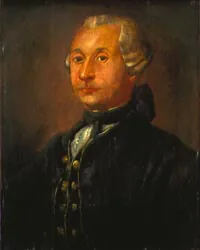
Father Demers, summoned before the court on 2 January 1787 by sieur Laterrière’s lawyer and friend, Alexandre Dumas, answered in his own defence on 10 February 1787, clearly and logically, through the lawyer A. Panet. It appears that Mr. Laterrière was very busy with his medical practice and could not devote the time required to the mills and to Father Demers’s projects.
On 8 August 1787 the decision of the three judges was filed with the notary Lévrard; it annulled the contract between the partners while granting slight compensation to Pierre de Sales Laterrière.
He had to leave the St-Pierre region in 1788 to obtain a medical degree at Harvard (Massachusetts). The authorities, anxious to bring order to medical practice in Canada, had begun to require a diploma in order to practise medicine; until then anyone at all could claim to be a disciple of Aesculapius, and quacks were commonplace.
Back in Québec with his degree, he settled at Trois-Rivières, Yamachiche and Baie-du-Febvre, between 1789 and 1799. During that period he worked to have midwives properly trained. But he never came back to live at St-Pierre.
In the burial registers of our parishes one often reads a note to the effect that the newborn was given emergency baptism by the midwife, who might be a neighbour or a relative with no training beyond an immense goodwill. By providing notions of anatomy, of hygiene and of particular techniques, he probably helped reduce the mortality that was filling our cemeteries.
That is perhaps the finest legacy he left us.
Jocelyne Lafond, Alain Manset
Members of the Société d’histoire et de généalogie Lévrard-Becquet (Lévrard-Becquet Historical and Genealogical Society)
Where this article sits
Read next
About the Society
A group of volunteers researching, preserving and publishing the history and genealogy of the Lévrard-Becquet seigneury since 2002.
shglb.com/en/les-medecins/