Chapter 2: Our region — the arrival of the first Europeans (1534–c.1600)
From yesterday to todayPart 3 of 5
From the Vikings of Anse aux Meadows to the Great Peace of Montréal in 1701, by way of Cartier and Champlain: the arrival of the Europeans, and why the settlement of New France was so slow.
Written in French by Alain Manset, February 3, 2024. Quotations from period documents are left in the original. Lire l’original en français.
…Then the white men appeared.
Irish monks, Vikings, Basque and Breton fishermen came to explore, fish, hunt and evangelize, but only now and then, occasionally; no permanent settlement was founded. Traces of a European presence can still be seen in Newfoundland and Labrador (Anse aux Meadows, Red Bay), but that attempt failed despite a promising start.
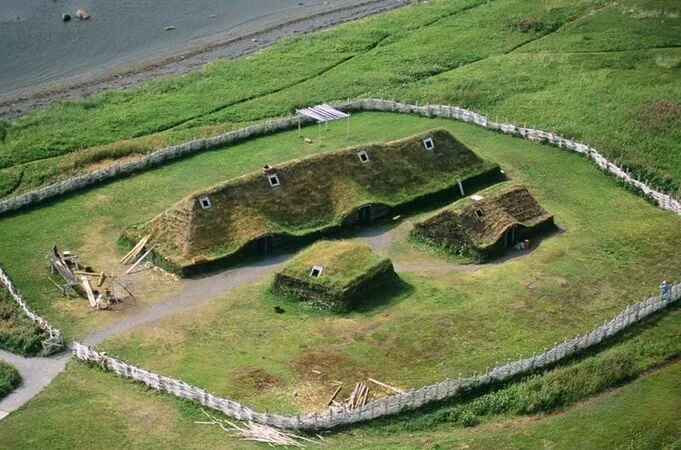
That region appears to have been relatively fertile, rich in game and fish; local iron ore was also used to make nails and other ironwork; and finally the milder climate of the period (the Medieval Climate Optimum) would have favoured a possible settlement. In the Bas-Saint-Laurent (Île aux Basques), whale hunters came every year to take whales and seals and render the precious oil used for lighting.
In 1534, Jacques Cartier, in the name of François 1er, king of France, “took possession” of the land on which he had come ashore, and noted that Iroquois frequented the St. Lawrence valley.
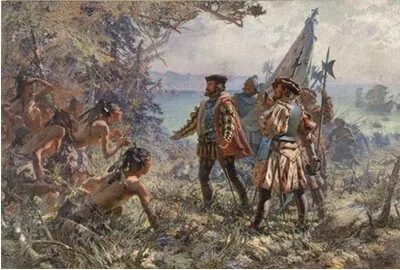
In 1535, Cartier met the Iroquois chief Donnacona in the course of two voyages on the St. Lawrence.
A third voyage, in 1541, ended in bitter disappointment.
Nearly 70 years passed before the European presence took hold, with François Gravé, sieur du Pont, and then Samuel de Champlain — who found no Iroquois at all on his voyage of 1603. The reason for their disappearance is still unexplained: epidemics, famine, war?
The founding of the city of Québec by Samuel de Champlain in 1608 was a turning point in the development of New France. At last!
At that time the territory around Saint-Pierre-les-Becquets was not occupied by any one tribe. The Abenaki then lived closer to the Atlantic coast, in what is now Maine, New Hampshire and Vermont, with some groups in the Eastern Townships. They were exposed to attacks by more aggressive Iroquoian groups and, pushed back by Dutch and English settlers, they found refuge in more hospitable regions, serving as a “buffer” between the French and the Iroquois tribes. The French, the Abenaki and the Algonquin cultivated their common interests, and the English, allied with the Iroquois, did the same. The ferocity of the Iroquois towards the French was legendary, but Abenaki raids on the English spread terror as well; such were the ways of the time!
The settlement of the territory named “Nouvelle-France” (New France) was slow, probably because of a preference for short-term profit over more lasting development. It was more profitable to work the fur trade, which brought in enormous sums within a single year, than to establish settlers, clear the forest and farm. The Dutch and then the English on the Atlantic coast did exactly the opposite: they peopled their whole territory, asserted their strength, and took a longer view.
The figures speak for themselves. Around 1650 the population of New France stood at about 2,000, while New England had reached 75,000; in 1680, 9,800 souls here and 140,000 among our neighbours; in 1745, 55,000 and 900,000.
A smaller and more scattered population fed a sense of insecurity in the face of Iroquois raids. The archives overflow with accounts of bloody attacks.
Major nuisances that are still with us today also put off the settlers of the day: mosquitoes, black flies and deer flies.

King Louis XIV tried to put a firmer policy in place, but court intrigue, power struggles, jealousies, endless quarrels, corruption and the rest held back the development of the colony in wasted time and energy. No matter! Vast domains were granted to “seigneurs” by the successive governors of New France, on condition that they settle, develop and lay out the territory. It was from 1645 onward that these “seigneuries” (seigneuries, the landholdings of the seigneurial regime) multiplied, above all along the banks of the St. Lawrence River. Major difficulties
Later, the Great Peace of Montréal signed with the Indians in 1701 brought a respite and the possibility of vigorous settlement.
In this series
- From Yesterday to Today
- Chapter 1: Our region, from prehistory to the arrival of the Europeans.
- Chapter 2: Our region — the arrival of the first Europeans (1534–c.1600)
- Chapter 3: Romain Becquet, seigneur in spite of himself (1640-1682)
- Chapter 4: Louise Mousseau (Monceau), the guardian (1635-1707)
Where this article sits
Read next
About the Society
A group of volunteers researching, preserving and publishing the history and genealogy of the Lévrard-Becquet seigneury since 2002.
shglb.com/en/notre-region-larrivee-des-premiers-europeens-1534-c-1600/